


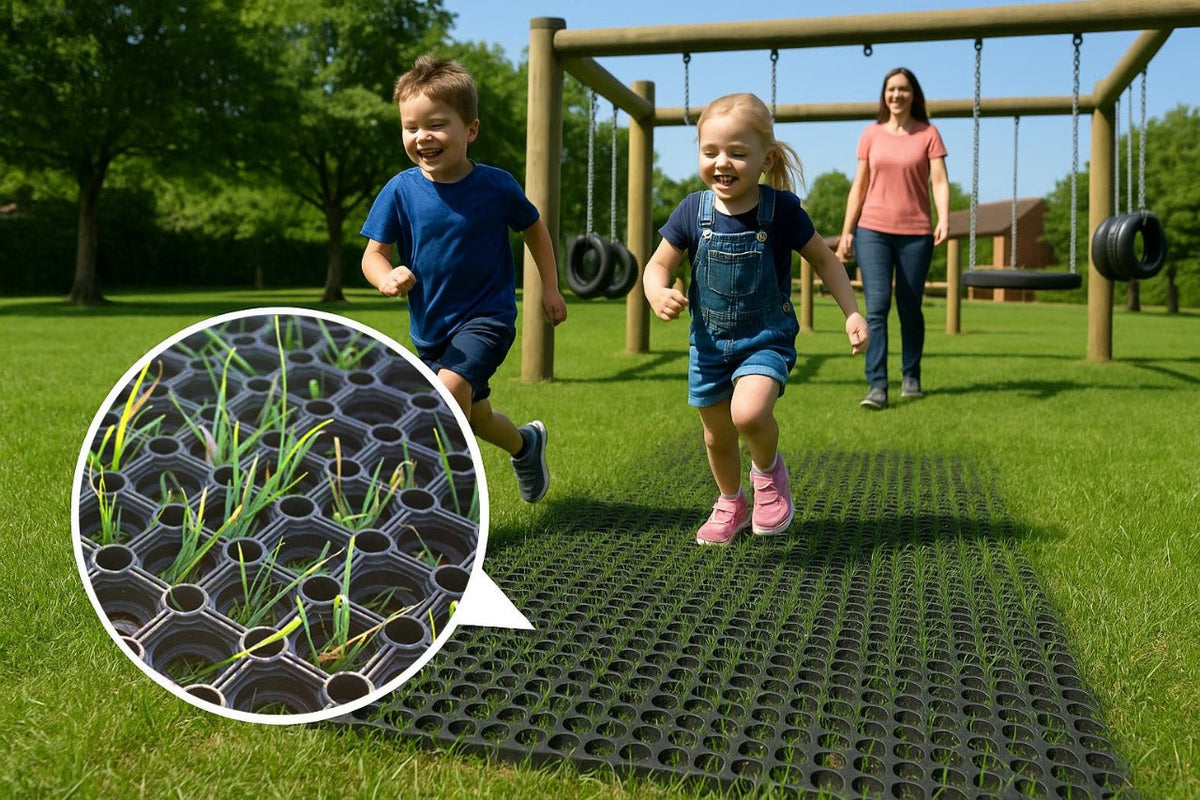
Quick answer: choose rubber grass mats if your play area is on grass and you want an affordable, DIY-friendly surface that keeps a natural look. Choose wet pour if you need a seamless, hard-wearing surface on a prepared hard base and have the budget for professional installation. Both can provide impact protection for playgrounds when specified for the right fall height.
What is the difference?
Rubber grass mats are open-hole recycled rubber mats laid directly on the lawn. Grass grows up through the holes, anchoring the mats and keeping the area green, while the rubber cushions falls and stops the ground turning to mud.
Wet pour is a poured-in-place surface: rubber granules mixed with a resin binder and trowelled onto a prepared base, usually a shock-absorbing SBR layer under a coloured EPDM top layer. It sets into a single seamless surface.
Rubber grass mats vs wet pour: side by side
| Rubber grass mats | Wet pour | |
|---|---|---|
| Base needed | Existing grass or soil | Prepared hard base (e.g. sub-base and tarmac or concrete) |
| Installation | DIY: lay, tie together and peg down | Specialist contractor; needs curing time |
| Cost | Low. Our playground grass mats start from £39.52 per 1.5m² mat | Significantly higher per m² once groundwork and labour are included |
| Fall height | Our 23mm mats are tested to 3.3m and 16mm to 2.1m (BS EN 1177) | Depends on the depth of the shock layer; specified per project |
| Look | Natural: grass grows through | Colourful, seamless, can include designs |
| Drainage | Drains naturally through the soil | Porous, but relies on the base draining properly |
| Repairs | Lift and replace a single mat | Patch repairs, which may show |
| Reusable | Yes, can be lifted and moved | No, permanent |
When rubber grass mats are the better choice
- Your play equipment already sits on grass.
- You want to install it yourself, in a day, without groundworks.
- You want the area to stay green and blend into the garden, park or school field.
- Budget matters, or the equipment may move in future.
- You also need to protect paths, gateways or worn areas of lawn from mud.
Popular choices: playground safety grass mats, 16mm and 23mm rubber grass mats, and 23mm rubber grass mat rolls for long paths.
When wet pour is the better choice
- The area is already hard-surfaced, or will be.
- You want a fully seamless finish with colours, games or logos.
- It’s a very high-traffic public site where a step-free, continuous surface is a priority.
We don’t install wet pour. If your play area is on a hard surface but you want a DIY option, rubber playground tiles can be laid directly onto concrete or tarmac and replaced tile by tile.
Fall height: getting it right
Whichever surface you choose, match it to the critical fall height of your equipment, the highest point a child could fall from. As a guide, our 16mm grass mats are tested to 2.1m and our 23mm mats to 3.3m. Always check the equipment manufacturer’s fall height and extend the surface across the full safety zone around the equipment. For public and school play areas, follow your inspector’s recommendations.
FAQs
Are rubber grass mats as safe as wet pour?
Both can meet BS EN 1177 for impact attenuation when used within their tested fall height. Safety depends on matching the surface to the equipment height, not on the type of surface alone.
Can rubber grass mats go on concrete?
No. They’re designed for grass and soil. On hard surfaces, use rubber playground tiles instead.
How long does it take for grass to grow through?
Usually 2–6 weeks, depending on the season and how well the grass is growing.
Is wet pour slippery?
Wet pour is generally slip-resistant, but like any outdoor surface it can become slippery with algae or moss if it isn’t cleaned regularly.
Related guides: Rubber grass mats buying guide · How to install rubber grass mats · Playground safety surfacing for schools
Shop rubber grass mats with free UK delivery, or call 01744 520 110 for bulk pricing.